Karate
Karate Contact Points
Contact points describe which exact body surface should strike the target. Correct use improves precision, control and safety.
Below you find common examples used in Kihon, Kata and Kumite.
Natural Weapons: Core Principle
Karate uses natural body surfaces for attack and defense. Training first identifies each striking surface, then teaches body mechanics to mobilize it, and finally conditions it to withstand concentrated impact.
In practice this means: correct shape, stable alignment and impact-ready structure. A weapon is useful only when placement, timing and body transfer are synchronized.
Closed Fist Fundamentals
Before striking with the fist, the hand must be locked in three steps: fold the finger tips, wrap the fingers tightly into the palm, then secure the thumb on the first two fingers. This creates a compact mass that does not collapse on impact.
Open Hand, Elbow and Knee
Open-hand weapons (Nukite, Shuto, Haito, Haishu, Teisho) require strong wrist fixation and precise finger tension. Intermediate weapons such as Empi and knee actions are decisive in close range where angle and body compression generate power.
Foot Weapons and Alignment
Heel, sole, instep, ball and blade of the foot each serve different tactical purposes. Their efficiency depends on ankle lock, toe position and exact relation between leg axis and impact surface.
Kentos

Standard fist-knuckle striking area used in many tsuki techniques.
Uraken

Back-fist striking surface, often used for fast, snapping attacks at short distance.
Tettsui

Hammer-fist impact area, effective for downward or diagonal power strikes.
Teisho

Palm-heel contact point, useful for controlled strikes and close self-defense actions.
Nukite

Spear-hand tip contact area formed by extended fingertips for precise targeting.
Nihon-nukite

Two-finger spear-hand variant used for highly focused and narrow target lines.
Shuto

Knife-hand edge used for both strikes and blocks with a stable wrist alignment.
Koshi

Ball-of-foot contact area, commonly used in thrusting kicks with direct penetration.
Sokuto

Outer-foot edge contact point, often used for yoko-geri style side kicks.
Teisoku

Sole-of-foot contact area, used for pushing, pressing and control-oriented applications.
Empi

Elbow contact point for very short range power and angular attacks; highly effective in close combat transitions and tight spaces.
Haito

Inner edge of the hand near the thumb, used in haito style strikes.
Haishu

Back-hand surface used for snapping and redirecting motions.
Ippon-ken

One-knuckle fist for focused pressure on small target areas.
Kakato

Heel impact area, typically used for stomping or backward kicks.
Haisoku

Instep contact point, commonly used in snapping kicks.
Ittsui
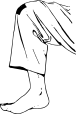
Knee-based close-range contact form used for compact and powerful strikes in a limited movement range.